AI systems store activity data in different ways. Ask three teams for last Tuesday’s logs and you will see it. One team offers access to LangSmith telemetry, because they build on LangChain. Another points you to the custom database tables where they record their logs. The third sends a link to their CrewAI dashboard.
The problem starts when you try to read them together. Governance questions cut across systems. Whether personal data showed up in outputs is a question about the whole organization, not one system. If every system logs decisions its own way, you cannot answer it.
The Canonical Evidence Schema is an open standard format for these records. It is published openly so the data remains accessible even if you stop working with EvidentAI, and your records stay usable by your team.
The decision event
A decision event is the main unit of record. It captures one AI action in enough detail to replay it later. It is built for audit use, not just logging.
Each event answers six questions.
-
Who decided. The acting agent, framework, and workflow are noted. Context matters. The same agent behaves differently in credit processing and customer support. Each action is tied to its business setting.
-
What it saw. Inputs are stored with integrity checks. Their content can be verified later without exposing sensitive data. If external documents were used, the exact file name and version are kept. This detail is often lost in other systems.
-
What was required. The policies in effect at that moment are evaluated. The event lists each rule and its result.
-
What was concluded. The outcome of the policy check is captured. Actions may be allowed, blocked, rerouted, or sent for review. The outcome is saved whether the process continues or stops.
-
What happened next. Enforcement results are tracked. If a human review occurs, the reviewer, the time, and the decision are all part of the event. Human input is treated as structured data.
-
Proof of integrity. Each event is signed. Audit teams can confirm that nothing has changed since capture. A record that cannot be verified should not be trusted.
Operational details such as processing time are also included. Governance and operations teams read the same entry, so there is no compliance copy of the truth competing with an engineering copy.
Normalization across frameworks
Different platforms define steps, traces, and tool calls in different ways. The schema does not force platforms to change. Adapters convert the native telemetry from LangChain, CrewAI, or custom stacks into one common structure.
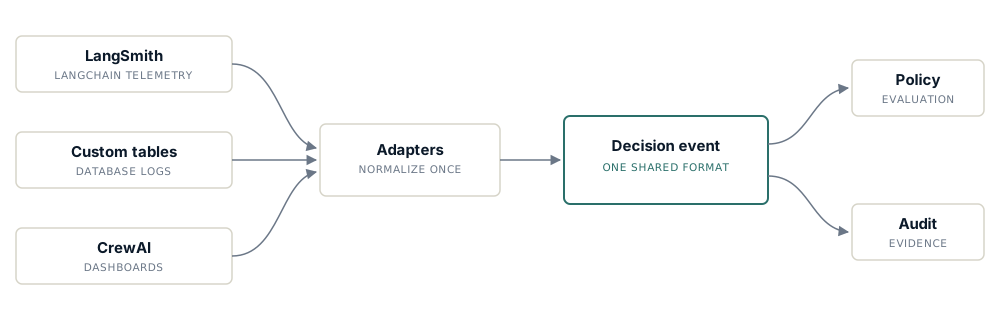
The conversion happens once. After that, every consumer works with the same format, and policies written once apply across all systems. A rule requiring personal data redaction, for instance, evaluates the same way whether the decision came from CrewAI or a custom workflow.
Binding events to obligations
Logs show what happened. Governance must also show what should have happened.
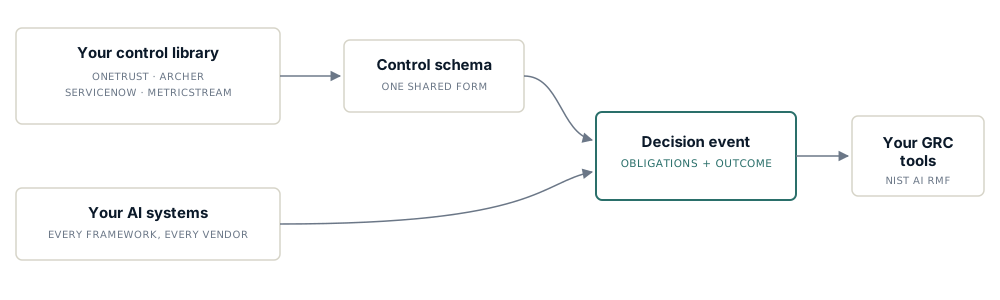
A control schema runs alongside the evidence schema: existing compliance rules are mapped into a shared form and linked to workflows. The obligations listed in the decision event match what your risk systems already track. Evidence flows into the GRC tools your teams already use, mapped to frameworks like NIST AI RMF, without manual transfer between engineering and compliance teams.
The importance of an open format
Audit data often outlives the software that created it. Retention periods stretch for years. Vendor relationships may not last that long. If logs sit in a vendor’s private format, you depend on that vendor to read your own records when an audit request arrives.
This schema is open and versioned. Your data stays readable and portable. You do not need EvidentAI to access it. We focus on delivering value rather than locking data in place.
Reviewing an example
The documentation includes a full example from a credit assistance workflow. It shows inputs, document versions, policy checks, routing to a human reviewer, and the signature. Reviewing a real event makes the design easier to understand. Contact us for the base schema or a walkthrough for your environment. The structure is the same in both cases.